

Meeting with industry stakeholders at WIN EURASIA 2026, Industrial Application Software (IAS), a global player in the enterprise software market, shared its integrated digital transformation approach that brings data from the shop floor into the process context through Canias’s ERP, IoT, big data, and decision support capabilities. IAS emphasizes that for AI to create value in manufacturing, reliable data architecture, real-time visibility, and integrated process management have become critical.
For manufacturing companies, the digital transformation agenda is being reshaped around automation, the Internet of Things (IoT), data analytics, and AI-supported decision-making processes. According to Deloitte’s 2026 Manufacturing Industry Outlook report, 80% of manufacturing executives plan to allocate at least 20% of their operational improvement budgets to smart manufacturing projects. The report notes that these investments focus on foundational technologies such as automation hardware, data analytics, sensors, and cloud computing, with manufacturers viewing smart manufacturing as one of the primary drivers of competitiveness over the next three years.
This transformation demonstrates that competitiveness in factories is shaped by the speed and reliability of data from the shop floor and its connection to decision-making processes. When data from machinery, lines, sensors, energy consumption, downtime, maintenance, and quality processes are evaluated alongside production orders, sales orders, costs, inventory, and planning information, companies gain a stronger foundation for decision-making. AI applications can also generate sounder analysis, foresight, and decision support over this integrated data structure.
Meeting with industry stakeholders at the 32nd International Automation and Machinery Technologies Exhibition, WIN EURASIA, recently held at the Istanbul Expo Center, IAS shared how manufacturing companies can transform data from the shop floor into operational decision-making power through the Canias platform’s ERP, IoT, data analytics, and AI-focused approach.
Reliable Data Architecture Prominent for AI in Manufacturing
As the level of automation on production floors rises, the volume of data generated by machines, lines, sensors, and quality control points also increases. For this data to create value for the company, it must be accurately correlated with operational processes. When machine operating time, line downtime data, energy consumption, or quality deviations are evaluated in conjunction with production orders, sales orders, materials, costs, and maintenance history, they can directly contribute to decision-making processes.
At this point, AI creates a new decision support layer for manufacturing companies. The value generated by AI applications in areas such as production planning, capacity utilization, anomaly detection, quality control, maintenance management, energy consumption, and sustainability performance is determined by the accuracy, continuity, and process context of the data feeding them. Therefore, in industrial AI applications, a reliable data infrastructure, real-time visibility, and integrated process architecture are among the topics that must be addressed together.
Canias Brings Shop Floor Data into Process Context
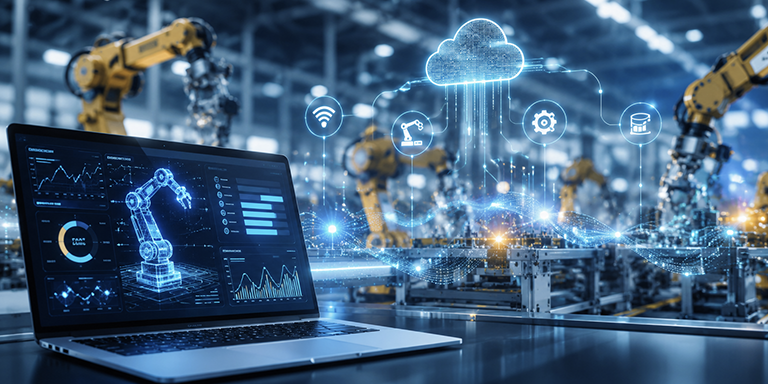
The integrated structure of Canias handles ERP, IoT, big data, and decision support capabilities on the same digital backbone, enabling manufacturing companies to manage shop-floor data in conjunction with business processes. By establishing a two-way connection between ERP servers and control units, sensors, and smart devices, the Canias IoT Gateway supports the real-time monitoring, analysis, and visualization of data such as resource consumption and environmental values. When predefined rules are triggered, monitored data can be automatically transferred to the ERP solution.
The Canias Production Intelligence (PRI) module offers companies a more visible operational structure in areas such as real-time reporting, KPI tracking, and production performance monitoring using data collected via automation and IoT tools. caniasIQ strengthens the decision support layer with its capabilities in data analysis, multidimensional evaluation, visualization, customizable dashboards, and real-time reporting. Meanwhile, iasDB’s big data infrastructure supporting diverse data types and TROIA’s flexible development platform establish a robust digital foundation that can adapt to companies’ evolving technological needs.
Canias’s integrated digital backbone approach paves the way for AI applications to operate with meaningful and contextual data. When data from the shop floor merges with process information within the ERP, AI-supported analyses can provide more robust decision support across various areas, from production planning to quality management, and from maintenance processes to cost optimization. In this way, Canias transforms data from a mere monitored element into one of the fundamental inputs for operational decisions.
“The Success of AI in Manufacturing is Directly Linked to Data Architecture”
Candoğan Olgun, AI Business Development Director at IAS, stated that for AI to create value in manufacturing, data must be handled along with its process context: “The success of AI in manufacturing is linked not only to the technical power of the algorithm but also to which process the data originates from. Knowing which production order, sales order, quality result, and cost item a piece of machine data corresponds to is among the fundamental conditions for sound decision support. While IoT collects data from the field, ERP provides this data with business context. Based on this integrity, AI offers foresight, analysis, and decision support to manufacturing companies. The Canias approach we shared at WIN EURASIA is built on this integrated structure. The data architecture and Data Governance infrastructure provided by Canias enable the context between data used in variable business areas within the system to be interpreted by AI, allowing the system to reach a point where it supports and makes decisions.”
While Deloitte’s 2026 Manufacturing Industry Outlook report notes that agentic AI applications can create value across various areas from production to supply chain and back-office processes, it also reveals that topics such as data, technology, governance, and workflow transformation must be evaluated together for large-scale implementation. This necessity amplifies the importance of robust digital infrastructure, clear process ownership, and reliable data flow for AI projects in manufacturing companies.
Physical AI
Another critical area of development for manufacturing companies is Physical AI. Alongside systems that make decisions based on collected data and business processes to support human decision-making, machine interaction systems in addition to human interaction systems continue to evolve.
Through bidirectional integration with machines, autonomous systems (such as AGVs), and robotic systems used in facilities via IoT infrastructure, the corporate memory and business practices of the company are fully integrated with the systems, establishing a process for the systems to operate independently. With this structure, corporate knowledge at the cognitive level is reflected into the physical world, creating autonomous production systems. With the AI layer positioned alongside Canias’s IoT technology, fully automated smart factories become a reality. Bottlenecks are identified, machines are directed according to production and maintenance plans, quality issues can be detected with sensors such as cameras, and production and maintenance plans can be managed in the systemic and physical worlds through solutions like anomaly detection, while logistics processes are managed with AGVs and automated conveyor systems. Variations in energy consumption are managed by correlating them with production flows. The Physical AI layer, working in tandem with Canias’s IoT and MES products, supports the digital transformation of facilities.
AI Creates a Layer of Foresight and Decision Support in Manufacturing
For manufacturing companies, AI enables faster interpretation of shop floor data and establishes a stronger data foundation for operational decisions. Evaluating production plans alongside capacity data, early detection of quality deviations, more predictive handling of maintenance needs, monitoring anomalies in energy consumption, and faster analysis of cost impacts are among the prominent use cases of this transformation.
Canias’s AI approach, integrated with its ERP and IoT architecture, assists manufacturing companies in evaluating their data sources within a single operational framework. Consequently, companies can manage technical data from the field in relation to production, quality, cost, maintenance, sustainability, and reporting processes. Thus, AI transforms into a layer that enhances operational visibility, accelerates decision-making processes, and strengthens a data-driven management culture for manufacturing companies.
Emphasizing that the potential AI offers to manufacturing companies can be fortified by the right data foundation, Candoğan Olgun continued: “AI provides manufacturing companies with the capability to interpret field data more quickly and to base operational decisions on a stronger data foundation. To realize this potential, data must be read in conjunction with production, maintenance, quality, cost, and planning processes. In our approach, AI is positioned as a natural extension of the ERP and IoT architecture. With Canias, we enable companies to make more predictive, traceable, and data-driven decisions in their production processes. ERP systems are now evolving from structures that generate reports for decision-making into structures that make decisions or provide recommendations at the point of decision-making.”
In the new phase of industrial transformation, competitiveness is shaped by the ability to manage shop floor data reliably, traceably, and integrated into decision-making processes. With Canias’s ERP, IoT, big data, and decision support capabilities, IAS supports manufacturing companies in elevating their field data into a more visible, meaningful, and decision-oriented structure on their digital transformation journey.