

Enterprise Sustainability Management (ESM)
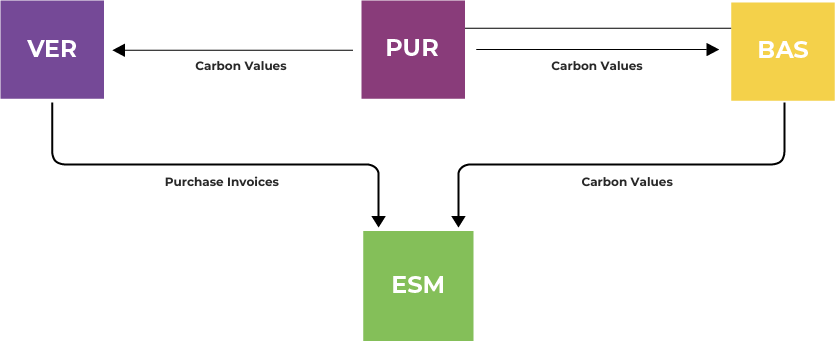
The caniasERP Enterprise Sustainability Management (ESM) module has been developed to effectively manage and analyze the carbon consumption of purchased or requested products.
With this module, the carbon footprint of products can be calculated both per defined scope and in total. Carbon consumption can be monitored for selected periods, recorded systematically, and reported through graphical dashboards.
Scope-Based Consumption
While calculating carbon consumption, the carbon consumption of products within the scope is calculated separately for each of the three universally defined scopes. Total consumption is observed across three separate scopes.
Product Group–Based Consumption
While calculating carbon consumption, the consumption of products under each scope can be observed based on their own product groups.
Automatic and Manual Calculation
Carbon consumption values can be calculated automatically from the invoices of purchased products if desired, or total consumption can be calculated by manually selecting the products for which consumption will be calculated.
Graphical Reporting
Carbon consumption results can be graphically reported based on company and within the desired date ranges according to distributions by Scope, Supplier, Product Group, and Factor.
Integration
-
Thanks to integration with the Invoice Control module, consumption calculations can be performed directly for purchased products.
- Thanks to integration with the Master Data module, consumption values are stored on a material basis and on a material–supplier pair basis.
Feature Overview
-
Ability to calculate consumption for desired periods
-
Ability to calculate consumption on a scope basis
-
Ability to calculate consumption on a product group basis
-
Manual or automatic calculation
-
Ability to monitor invoices subject to consumption
-
Updating carbon values on invoices subject to consumption
-
Reporting of scope-based consumption distributions
-
Reporting of supplier-based consumption distributions
-
Reporting of product group–based consumption distributions
-
Reporting of factor-based consumption distributions