

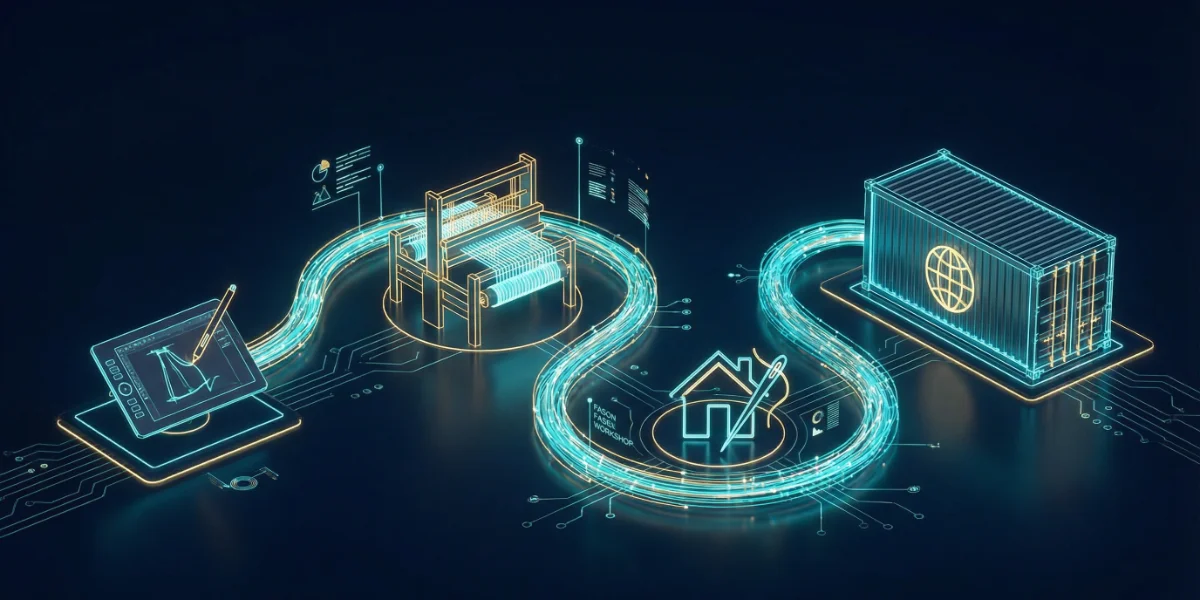
ERP for the Textile Industry provides a critical digital infrastructure for textile companies to manage their operations sustainably in the face of increasing competition, short lead-time pressures, and high-variant production structures. The prevalence of subcontracted production networks, the increasing number of collections, and rapidly changing customer demands have made it nearly impossible to manage production, planning, and delivery processes through manual or fragmented systems. At this point, ERP makes the entire process—from order to production, and from inventory to shipment—controllable from a single center.
ERP for the textile industry does not only increase operational efficiency; it provides a strategic competitive advantage by digitizing subcontractor tracking, collection planning, and lead-time (delivery) processes. Thanks to a properly configured ERP infrastructure, businesses can foresee production delays, monitor costs in real-time, and manage customer commitments with confidence. This digital transformation approach, spanning from production to delivery, supports both the daily operational needs and long-term growth goals of textile firms.
Why is Digital Transformation Inevitable in the Textile Sector?
The textile industry is one of the sectors with the highest operational complexity due to fast fashion cycles, frequently changing collections, high product variation, and intensive subcontracted production. Rising cost pressures, shorter delivery times, and increasing customer expectations have made it unsustainable for firms to proceed with manual processes or disconnected software. Here, digital transformation emerges not just as an efficiency booster, but as a fundamental requirement for maintaining competitiveness.
ERP systems, at the heart of digital transformation, offer textile companies the opportunity to manage all processes from production to delivery through a single source of truth. Responding quickly to order changes, monitoring production in subcontracted workshops in real-time, anticipating lead-time risks, and keeping costs under control are only possible with an integrated digital infrastructure. Therefore, digital transformation in the textile sector is not a choice; it has become an inevitable necessity for growth, sustainability, and competing in global markets.
Essential Processes in ERP Systems for the Textile Sector
The primary requirement for a textile-specific ERP system is its ability to handle industry-specific processes beyond standard ERP logic. Product structures based on model, color, size, and variant are directly linked to collection management, sampling processes, and revision tracking. Therefore, textile ERP solutions should handle the path from order to production not just based on quantity, but together with the Bill of Materials (BOM) and operational details.
Furthermore, subcontractor tracking, lead-time management, production planning, and real-time cost calculation are indispensable elements of textile ERP systems. Jobs sent to subcontracted workshops, semi-finished goods movements, quality controls, and delivery dates must be traceable through a single system. At the same time, the integrated operation of MRP, capacity planning, and shipment processes grants firms both operational transparency and accurate decision-making capabilities.
Subcontractor Tracking: Managing Fragmented Production from a Single Center
In the textile industry, subcontractor tracking is one of the most critical success factors for ERP projects. In structures where multiple workshops are worked with simultaneously, operational control is quickly lost if work order tracking, semi-finished goods movements, quality control results, and lead-time management are not monitored from a single center.
Canias ERP treats subcontracted production not just as an “outsourced” resource, but as an integrated part of the main production process. Work order creation based on subcontracted workshops, operation progress tracking, subcontractor cost calculation, and performance analysis are all performed in real-time via Canias ERP. This allows textile firms to foresee delays, clarify costs, and manage their subcontractor network based on data.
Digitizing Collection Planning Processes with ERP
Collection planning is not just about design; it is directly related to cost, manufacturability, and lead-time success. Managing collections via Excel or manual systems in structures with a high number of models, colors, sizes, and variants leads to serious decision-making errors.
With Canias ERP, collection-based BOMs, sampling processes, revision tracking, and collection costing are gathered under a single digital structure. Through collection planning on the ERP, firms can clearly see profitable collections, risky models, and production scenarios suitable for capacity even before starting production.
Lead-Time (Termin) Processes: Time Management from Order to Delivery
Lead-time management in the textile industry is a critical process that directly affects customer satisfaction and brand reliability. Any minor disconnect in the chain—from order approval to production plan, and from subcontracted workshops to shipment—leads to delivery delays and increased costs.
Canias ERP manages lead-time processes through order-based digital planning instead of manual calendars. Production deadlines, subcontractor delivery dates, and shipment plans work interdependently within the ERP. Consequently, orders at risk of delay are identified in advance, revised deadlines are automatically reflected in all processes, and firms manage their delivery commitments with confidence.
Transparency and Efficiency with Real-Time Production Tracking
To make accurate decisions in textile production, real-time production data is required rather than historical reports. When it is not clearly seen which work order is at which stage, which line is experiencing a delay, or where waste (scrap) is occurring, efficiency losses become inevitable.
With Canias ERP, production can be monitored instantly on the basis of operation, line, and workshop. Actual production quantities, downtimes, waste rates, and performance data become immediately visible on the system. This transparent structure allows textile firms not only to identify problems but to ensure increased efficiency, time savings, and operational control by continuously improving production processes.
A Specialized Approach to the Textile Industry with Canias ERP
In textile enterprises, selecting an ERP is not merely a “general-purpose” software decision. This is because collection planning, subcontracting (outsourcing) tracking, lead time processes, high-volume variant management, and rapid order changes must all be managed simultaneously. Centering on this reality, Canias ERP designs textile processes end-to-end with a digital transformation logic, from production to delivery.
What does Canias ERP’s “Sector-Specific” approach to textile mean?
The following areas are interconnected within a single, unified data flow:
- Collection Planning
- Management of model–color–size–variant structures within the ERP.
- Tracking of samples, revisions, approvals, and versions.
- Visibility of collection-based costing and profitability.
- Subcontracting (Outsourcing) Tracking
- Work order tracking and operation progress status based on individual workshops.
- Semi-finished product tracking and control for sent/received goods.
- Subcontractor-based performance analysis and early detection of delay risks.
- Lead Time Processes
- Accurate reflection of order deadlines onto the production plan.
- Early warnings and actions for tasks showing a risk of delay.
- Time management from order to delivery, extending all the way to the shipping stage.
What do textile companies gain with Canias ERP?
Clear answers to the reader’s question: “How will this benefit me?”
- Operational Transparency: Where is the production, who has it, and at what stage is it?
- Lead Time Reliability: Fewer surprise delays and improved customer satisfaction.
- Cost Control: Cost tracking based on actual data rather than estimates.
- Flexibility: The ability to reconfigure processes when workflows change.
The Core Difference That Makes Canias “Brand-Specific”
The Canias ecosystem offers a structure that is not just an ERP, but one that can expand with IoT, Business Intelligence (BI), and advanced technology layers when needed. This approach provides a powerful foundation for real-time production tracking, rapid reporting, and scalable digital transformation in the textile industry.