

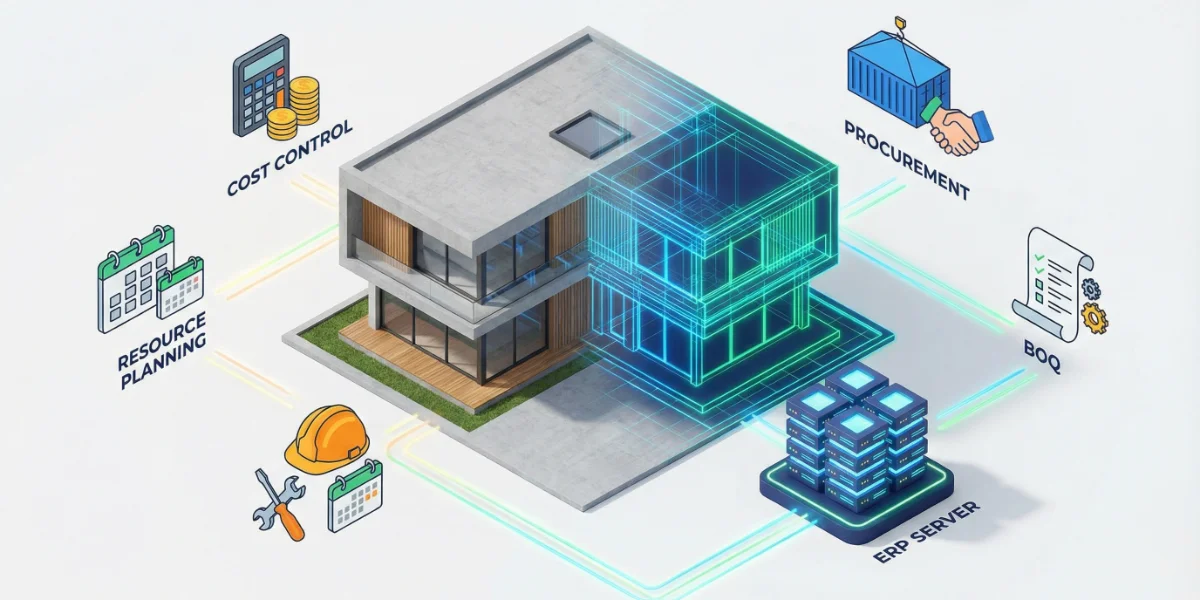
ERP for Construction Companies

For project-based firms, ERP for Construction Companies has become a strategic necessity in the face of increasing cost pressures, complex field operations, and time management challenges. Managing multiple construction sites, fluctuating bill of quantities (BOQ) items, and intensive resource utilization makes it difficult to control processes through manual methods. At this point, ERP systems strengthen control by making project and cost management manageable from a single center.

ERP for construction companies does more than just digitize operations; it accelerates decision-making processes and increases predictability in projects. The integrated execution of critical processes such as site management, bill of quantities (BOQ), and resource planning ensures early detection of cost variances. Thus, companies gain the advantage of managing their projects with a data-driven and proactive approach rather than a reactive one.

The Critical Role of Project and Cost Management in Construction

The fundamental factor determining profitability in construction projects is how effectively project and cost management is executed. Diverse work items, variable field conditions, and long project durations render manual tracking methods insufficient.

Every project has its own unique budget, estimation, and resource needs. Within this structure, the bill of quantities (BOQ) serves as a critical reference point for clearly seeing the difference between planned costs and actual expenditures. In firms without an ERP infrastructure, this comparison is often made too late. Consequently, by the time cost variances are noticed, the project may have already reached a risky point.

Thanks to its project-based architecture, Canias ERP provides construction firms with the following advantages:

  • Defining project budgets from a single center.
  • Integrated monitoring of estimation, procurement, and progress payment (hakediş) data.
  • Instant reflection of actual costs onto the project.

In this way, firms do not just report the past; they make decisions by ensuring forward-looking cost control.

Centralized Control in Site Management via ERP

One of the greatest operational challenges in the construction sector is the simultaneous management of multiple sites. Delayed, missing, or inconsistent data from sites directly affects decision-making.

Site management requires the coordinated handling of not just field tracking, but also budget, resources, and time. Without an ERP, these processes are typically scattered across phone calls, emails, and Excel files. Centralized control provided by ERP eliminates the disconnect between the field and the head office. All sites are monitored through a single system and become comparable.

Key gains of ERP-supported site management include:

  • Real-time visibility of site-based expenditures.
  • Balancing material, equipment, and labor through resource planning.
  • Simultaneous tracking of planned work schedules versus actual progress.

Canias ERP integrates data from the site with project, cost, and finance modules, offering management full control via a single screen. This structure transforms field management from reactive to proactive.

Bill of Quantities (BOQ) and Real-Time Tracking of Actual Costs

Budget control in construction is not achieved simply by knowing the planned cost. The critical point is the real-time comparison of the bill of quantities against the actual costs incurred in the field.

In manual systems, the estimation budget is often prepared at the start of the project and loses its relevance as the process moves forward. This leads to late realization of cost variances and profit margins spiraling out of control. With an ERP infrastructure, BOQ items are directly linked to procurement, progress payments, and expense records. Thus, every expenditure is automatically matched with the relevant project and estimation line.

Canias ERP provides construction firms with this critical visibility:

  • Instant comparison of the bill of quantities with actual costs.
  • Early detection of project-based cost variances.
  • The ability to take precautions before the risk of budget overrun occurs.

Essential Functions in ERP for Construction Companies

ERP systems used in construction must differ from standard commercial software. A project-based structure, field operations, and a cost-oriented management approach necessitate specialized functions.

Key needs for construction firms when selecting an ERP include:

  • Project-based budget and cost tracking.
  • Integrated management of estimation, progress payments (hakediş), and subcontractor processes.
  • Head office–field integration for site management.
  • Resource planning for human resources, equipment, and materials.

When these functions operate independently, control is lost. The power of ERP lies in uniting all these processes under a single data structure. Canias ERP offers all the functions construction firms need in an integrated manner, allowing for end-to-end project management without moving data between different software.

Canias ERP’s Specialized Approach to Construction Projects

Every project in construction is different. Duration, budget, site conditions, and resource needs vary. Therefore, the ERP approach for construction must go beyond standard process templates.

Canias ERP enables project-based management with an architecture that centers on construction projects. Budget, estimation, procurement, progress payments, and field data are linked under a single project structure.

Distinguishing features of Canias’s approach include:

  • Managing each project with an independent budget and cost structure.
  • Full integration between the site, head office, and management levels.
  • Flexible configuration that adapts quickly to changing field conditions.

Competitive Advantage Through Digitalized Project and Cost Management

In the construction industry, competition is no longer driven solely by bid prices. Completing projects on time, keeping costs under control, and planning resources accurately have become the fundamental elements that set firms apart.

In firms that have not yet digitalized, project and cost management often lag behind. Data is reported only after it is collected, leading to delayed decision-making. In today’s competitive environment, this approach creates a significant disadvantage.

ERP-supported digital project and cost management provides firms with instantaneous visibility. Management can foresee not only the current status but also the risks in the upcoming stages of a project.

The competitive advantages provided by this digital approach include:

  • More controlled exploration and cost management
  • Data-driven allocation of resources
  • Predictable profitability and sustainable growth

Construction firms digitalizing with Canias ERP base their decisions on real-time data rather than intuition. This translates to fewer surprises in projects, higher levels of control, and a lasting competitive advantage in the market.

ERP for Construction Companies: Frequently Asked Questions (FAQ)

Why should an ERP for construction companies differ from standard ERP solutions?

Construction firms operate on a project basis, where every project has a unique budget, exploration (survey), and resource requirement. Standard ERP solutions cannot fully accommodate this structure. An ERP for construction must center on project and cost management while integrating site operations, exploration, and progress billing (hakediş) processes.

What advantage does ERP provide in construction site management?

Thanks to ERP systems, site management is conducted independently from the head office yet remains fully integrated. Expenditure, labor, and progress data from the field are reflected in the system instantly. This allows management to track sites in real-time rather than retrospectively.

How is the Bill of Quantities (BoQ/Exploration Summary) managed within the ERP?

In an ERP infrastructure, the BoQ is directly linked to purchasing, progress billing, and expense records. This allows for a continuous comparison between the planned budget and actual costs. Cost variances become visible at an early stage, protecting project profitability.

Can resource planning be done effectively without an ERP?

For construction firms managing multiple sites, attempting resource planning via manual methods carries serious risks. With an ERP, human resources, equipment, and material usage are planned on a project-by-project basis. This prevents bottlenecks, idle capacity, and unplanned expenditures.

How does Canias ERP provide a competitive advantage to construction firms?

Canias ERP controls costs, strengthens site-to-office integration, and accelerates decision-making processes through its project-based architecture. This framework provides construction firms with more predictable projects, sustainable profitability, and a permanent competitive edge.