블로그
The question of “How to use ERP for inventory and warehouse management?” is a critical topic in today’s business world, where enterprises of all sizes—from manufacturing to retail—aim for efficiency and cost optimization. Accurate inventory management is vital for balancing cash flow, increasing customer satisfaction, and preventing unnecessary costs. Integrated enterprise resource planning systems, such…
The question of “What should be considered when selecting an ERP system?” is of strategic importance for every business stepping into the digital transformation process. Choosing the right ERP directly affects not only the automation of business processes but also fundamental elements such as efficiency, cost control, sustainability, and competitiveness. An ERP solution that aligns…
Enterprise Resource Planning (ERP) systems and accounting programs are two fundamental tools used to manage financial processes. However, these two concepts are frequently confused. In reality, the difference between them is significant enough to determine the maturity level of a business’s digital transformation journey. At Canias, with over 35 years of experience in digital transformation,…
Enterprise Resource Planning (ERP) is a comprehensive software system used to manage all core business processes of an enterprise in an integrated manner. ERP systems consolidate various functions—such as accounting, procurement, project management, risk management, regulatory compliance, supply chain management, and production planning—under a single roof. Consequently, companies achieve significant advantages in data integrity, operational…
Digitalization has rapidly become a transformative process that affects business operations in nearly every sector of today’s world. If you are curious about how to leverage digitalization to optimize business processes and increase efficiency as you embark on your digital transformation journey, you’re in the right place. In this article, we will explore how you…
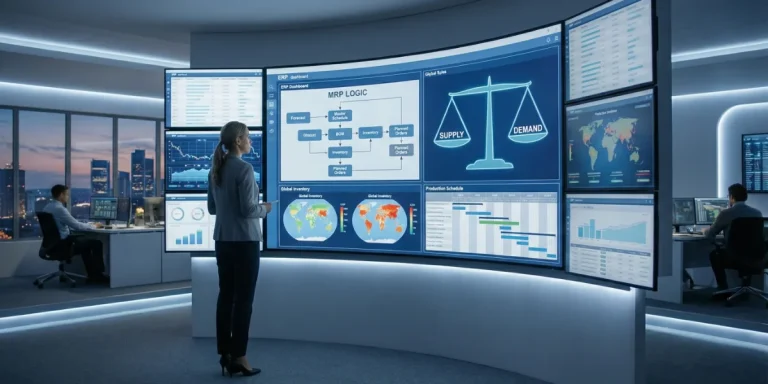
You have sales orders, you have received your forecasts, you have determined your independent demands, in other words, your systemic demands have been determined in general. Let’s say you have the basic datas of the products, such as the BOM, the routes, as well as the parameters that affect material requirement planning, like safety stocks…
A concept ever-present in our business lives, risk can be defined as an uncertain element or outcome involving harm, loss, or danger. In other words, Risk is the probability of something having a negative impact on objectives. There can be many risks in your business and its processes. These risks should be properly managed to…
ERP solutions are systems aimed at the optimum utilization of an enterprise’s existing resources. They serve to record and preserve all types of information and documents that are valuable or potentially valuable—providing added value today or in the future—within a centralized system. ERP software contains an “experience pool” designed to provide solutions for problems that…
Enterprise Resource Planning (ERP) systems offer comprehensive solutions that enable business processes to be managed more efficiently and effectively by integrating them into a centralized platform. Understanding the wide range of application areas and benefits provided by ERP applications, alongside the unique advantages of Canias ERP, helps organizations make informed decisions when selecting their digital…
ERP (Enterprise Resource Planning) is a software system used to manage the daily business activities and departmental processes of companies. It integrates operational transactions—such as sales, procurement, production planning, manufacturing, and shipping—with the business processes of departments including accounting, finance, import-export, human resources, R&D, quality assurance, and engineering. The History of ERP The 1970s and…
The origins of ERP systems can be traced back to MRP (Material Requirements Planning) software. The subsequently developed system, known as MRP II, was defined as Manufacturing Resource Planning. Thus, a system that was previously used solely for planning material requirements evolved toward planning production requirements, expanding the scope of the business operations. Following MRP…
ERP solutions are systems aimed at the optimum utilization of an enterprise’s existing resources. They serve to record and preserve all types of information and documents that are valuable or potentially valuable—providing added value today or in the future—within a centralized system. ERP software contains an “experience pool” designed to provide solutions for problems that…
디지털 전환에서 ERP의 역할과 중소기업에게 중요한 이유 디지털 전환은 중소기업이 경쟁력을 강화하고 지속 가능한 성장을 위해 필수적으로 필요한 과정입니다. 이 과정에서 ERP 시스템은 비즈니스 프로세스의 디지털화를 촉진하는 핵심 역할을 수행합니다. 그렇다면 ERP는 무엇이며, 디지털 전환에서 중소기업에 어떤 가치를 제공할까요? ERP(전사적 자원 관리) 시스템은 기업의 다양한 업무 프로세스를 하나의 통합된 플랫폼에서 관리할 수 있도록 지원하는 소프트웨어입니다….
오늘날의 비즈니스 환경에서 지속 가능성은 단순한 필요성이 아니라 기업의 경쟁력을 강화하는 중요한 요소로 자리 잡고 있습니다. 환경적 책임을 다하면서도 경제 성장 목표를 달성해야 하는 요구는 기업들이 새로운 해결책을 모색하도록 만듭니다. 이러한 필요성에 따라 IAS는 기업의 지속 가능성 여정을 지원하기 위해 새로운 Canias 기업 지속 가능성 관리 모듈을 개발했습니다. 이번 기사에서는 이 모듈의 특징과 기업에 제공하는…